
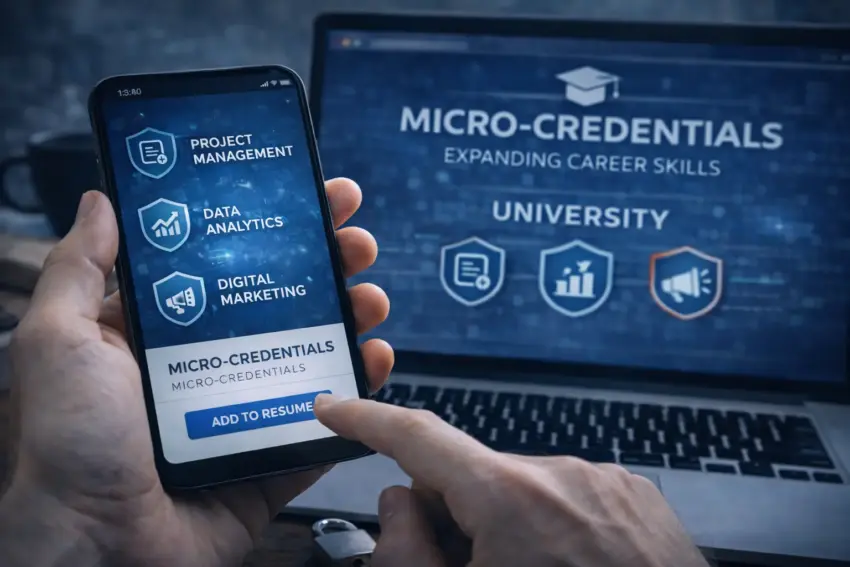
Universities in Germany and across Europe are expanding micro-credential programs as employers demand faster, more targeted skills and workers look for flexible ways to reskill without committing to full degree pathways. The short-format qualifications—often delivered online or in blended formats—are designed to certify specific competencies in areas such as data analysis, cybersecurity, AI, project management, healthcare administration, and sustainability.
University leaders describe micro-credentials as a response to a job market that changes more quickly than traditional curricula. Instead of waiting years for a full degree completion, learners can earn stackable certificates that demonstrate practical skills and can sometimes be combined toward larger qualifications later.
What micro-credentials are and how they work
Micro-credentials typically cover a narrow set of learning outcomes and are assessed through projects, exams, or practical demonstrations. They usually require fewer hours than standard modules, and many are structured around workplace-relevant tasks. Programs may be offered directly by universities or through partnerships with industry and education platforms.
Common formats include short certificate courses lasting several weeks, intensive bootcamp-style programs, and modular offerings that allow learners to progress in small steps. In some cases, universities issue digital credentials that can be shared on professional profiles and verified online.
Why universities are investing now
Administrators point to several overlapping trends. Employers increasingly hire for skills rather than purely for titles, especially in technology and business roles. At the same time, industries facing automation and demographic change are pushing for continuous training—creating demand for education that fits around full-time work. Universities also see micro-credentials as a way to reach new groups of learners, including mid-career professionals and international audiences.
For institutions, micro-credentials can strengthen links with local employers by aligning course content with immediate workforce needs. For regional economies, the model can support faster talent development in shortage areas.
How micro-credentials connect to degrees
A key selling point is “stackability.” Some universities allow micro-credentials to count as credit toward a diploma or master’s program, depending on assessment standards and accreditation rules. Others use them as standalone qualifications that demonstrate readiness for entry-level roles or internal promotion.
However, recognition is not uniform. Education experts note that micro-credentials only provide real value if employers understand what they certify and if universities apply consistent quality assurance. This is why many institutions are focusing on transparent learning outcomes, clear workload estimates, and standardized grading or competency frameworks.
What employers are looking for
Recruiters say micro-credentials are most useful when they signal applied ability, not just course completion. Programs that include real projects, portfolio work, or proctored assessments tend to carry more weight. Employers also value credentials that align with recognized frameworks or that are co-developed with industry partners.
- Clear skills mapping to job roles and competency frameworks.
- Practical assessment through projects, labs, or case studies.
- Verified identity and integrity for exams and submissions.
- Up-to-date content tied to current tools and methods.
Concerns: quality, overload, and inequality
Critics warn that micro-credentials could become confusing if the market is flooded with inconsistent labels. Without common standards, learners may struggle to judge which certificates are respected. There are also concerns that short credentials could shift training costs onto individuals, particularly in sectors where employers previously provided structured development.
Universities counter that quality assurance and transparency are central to their model, and that micro-credentials can widen access by providing affordable entry points. Still, experts emphasize the importance of financial support and guidance so that micro-credentials do not become another barrier for lower-income learners.
“The promise is speed and relevance. The risk is fragmentation—too many badges that employers can’t interpret.”
What to watch next
Universities are expected to expand micro-credential catalogs further, with stronger ties to regional labor shortages and more partnerships with employers. Policymakers and accreditation bodies are also likely to increase attention on standards, credit recognition, and cross-border portability.
If those frameworks mature, micro-credentials could become a routine part of higher education in Germany—supporting lifelong learning, faster reskilling, and clearer pathways between education and employment.