
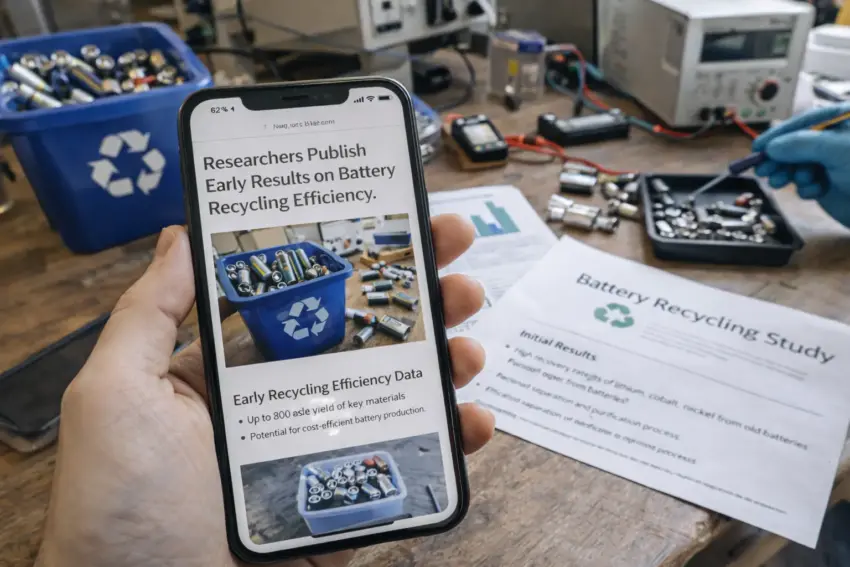
Researchers are reporting early results that suggest battery recycling can become more efficient—both in how much critical material is recovered and in how consistently performance can be measured across different processes. The findings come as Europe scales up recycling capacity and regulators push for clearer, comparable metrics on what recyclers actually recover from end-of-life batteries.
A key recent step is methodological: the EU’s Joint Research Centre (JRC) has outlined a standardized approach for calculating recycling efficiency and material recovery for waste batteries, focusing on key raw materials such as cobalt, copper, lead, lithium, and nickel. Supporters say common calculation rules make it harder to “talk past each other” when comparing plants, technologies, and reported recovery rates.
What “recycling efficiency” means in practice
In research and industrial reporting, efficiency is increasingly discussed in two layers: how much of each target metal is recovered into usable outputs, and how much energy and chemical input is required to do it. Recent comparative studies continue to highlight trade-offs between the most common routes—pyrometallurgy, hydrometallurgy, and “direct” recycling—depending on battery chemistry, contamination, and plant design.
Early signals: where researchers say gains are coming from
Across early-stage pilots and process reviews, researchers point to several areas that can raise recovery and reduce losses:
- Improved pre-treatment and sorting to reduce impurities before recovery steps begin.
- Process optimization for specific chemistries (for example, different approaches for NMC vs. LFP batteries).
- Direct recycling approaches that aim to preserve active material value rather than breaking everything down to base metals first.
- Automation and scale-up engineering to stabilize output quality at high throughput.
Industry pilots are also increasingly focused on closed-loop concepts—recovering material and feeding it back into cell production—because that is where cost and climate benefits can compound if quality is stable.
Why measurement standards matter as much as chemistry
One reason “early results” can be hard to compare is that different projects report different endpoints: some emphasize black mass yield, others report individual metal recovery, and others focus on life-cycle impacts. The JRC’s work is meant to reduce that fragmentation by proposing a harmonized way to calculate recycling efficiency and recovery for key materials across battery types.
“If efficiency is measured differently from one process to another, it’s impossible to know whether improvements are real—or just reporting differences.”
What’s next for recycling performance claims
Researchers expect the next wave of results to focus on industrial-scale validation: stable recovery over long runs, better handling of mixed feedstocks, and tighter control of impurities that can limit reuse in new batteries. Separate analysis from Fraunhofer ISI has also emphasized how quickly recycling capacity is expanding in Europe, increasing pressure to prove performance with consistent data rather than marketing claims.
For policymakers, the direction is toward clearer reporting and comparability. For industry, the challenge is turning promising lab and pilot outcomes into repeatable, auditable performance at scale—while keeping energy use, costs, and environmental impacts competitive.