
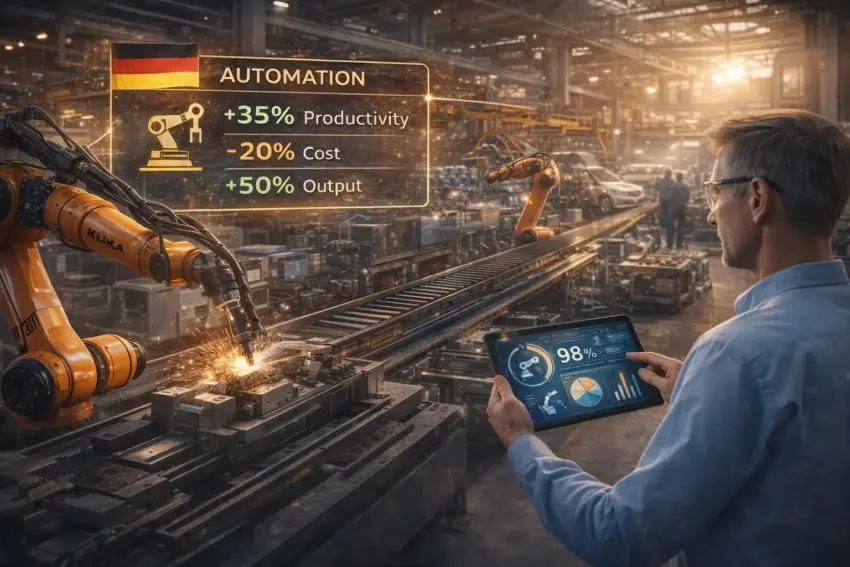
Germany’s mid-sized firms are increasing investment in automation tools as they respond to labor shortages, rising cost pressure, and growing competition from more digitized rivals. For many Mittelstand companies, automation is no longer limited to factory-floor robotics. It is expanding into office workflows, procurement, finance, customer service, and maintenance—areas where software can reduce repetitive work and shorten turnaround times.
Executives say the focus has shifted from “automation as experimentation” to “automation as productivity infrastructure.” Instead of isolated pilots, firms are increasingly budgeting for broader rollouts, staff training, and system integration—aiming for measurable gains in output quality, speed, and resilience.
What companies are automating first
Most mid-sized firms start with processes that are high-volume, rule-based, and prone to manual errors. Typical early targets include:
- Invoice and billing workflows (data capture, validation, approvals, payment scheduling).
- Inventory and replenishment (automatic reorder triggers, stock alerts, demand forecasting support).
- Customer support triage (ticket classification, suggested replies, routing to specialists).
- Production planning (capacity scheduling, job sequencing, exception handling).
- Quality documentation (automated reporting, traceability logs, compliance records).
- Predictive maintenance (sensor-based alerts and maintenance scheduling).
Many firms are combining traditional automation (rules and workflows) with AI-assisted tools that help categorize requests, extract information from documents, or flag anomalies in operational data.
Why investment is accelerating
Managers cite a mix of structural and short-term factors. Skilled labor remains difficult to find in many regions, and companies are trying to protect capacity without relying solely on hiring. At the same time, customers expect faster delivery times and better tracking, while suppliers demand tighter planning and clearer documentation. Automation is increasingly seen as a way to stabilize service levels even when staffing and supply conditions fluctuate.
In addition, many mid-sized firms report that the economics of adoption have improved: cloud tools can be deployed faster than large on-premise projects, and modular platforms make it easier to automate in stages.
Which tools are gaining traction
Automation spending is spreading across several categories, depending on industry and digital maturity:
- Robotic process automation (RPA) for repetitive screen-based tasks in legacy systems.
- Workflow and process orchestration to standardize approvals and handoffs across teams.
- Industrial automation including robotics, machine vision, and smart sensors.
- AI-enabled document processing for orders, invoices, shipping documents, and contracts.
- Chat and voice assistants for internal IT support and customer inquiries.
- Analytics and monitoring to track performance, exceptions, and process bottlenecks.
Companies with older IT landscapes often prioritize tools that can “wrap around” existing systems, while those already running modern ERP platforms focus on native automation features and data-driven optimization.
“The biggest gains come when automation removes the handoffs—when data flows end-to-end without people re-entering the same information in three systems.”
Challenges: integration, skills, and trust
Despite growing budgets, the Mittelstand faces common obstacles. Integration remains a major hurdle, especially where automation needs clean, consistent data across ERP, CRM, and production systems. Firms also report a skills gap: automation projects require process expertise, IT security, and change management, not just software licenses.
Where AI is involved, trust becomes central. Companies are increasingly setting rules for human oversight, defining when automation can act on its own and when it should only recommend actions. Many are also building audit trails so teams can see why a system made a decision and how it can be corrected.
What comes next
In the next phase, mid-sized firms are expected to focus less on isolated automation wins and more on scaling: standardizing processes across sites, measuring outcomes consistently, and strengthening governance for AI-driven tools. Successful adopters are likely to treat automation as a continuous program—combining technology rollout with training, data cleanup, and clear accountability.
For Germany’s Mittelstand, the direction is clear: automation is increasingly viewed as a core lever for competitiveness, helping companies deliver reliably with fewer manual bottlenecks and greater operational flexibility.