
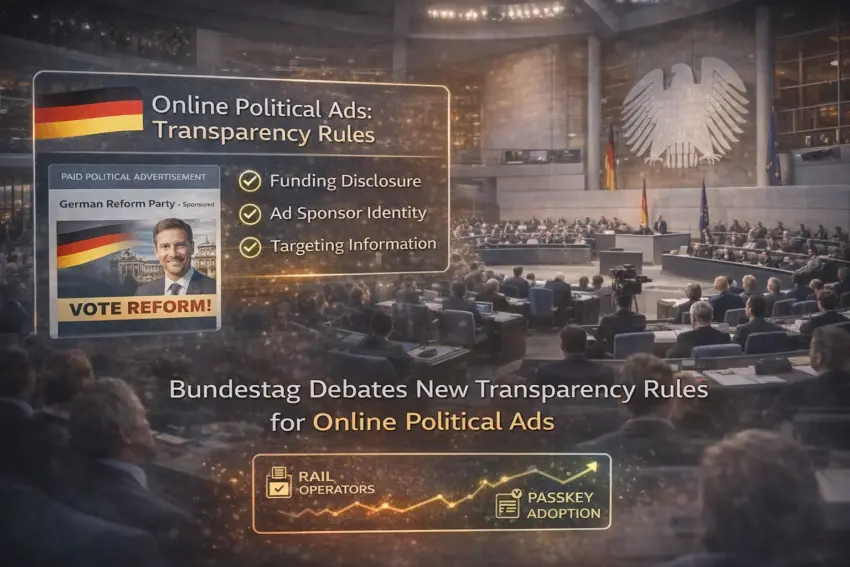
Germany’s Bundestag is debating new transparency rules for online political advertising, with lawmakers focusing on how paid political messages should be labeled and what disclosures platforms and advertisers must provide. The aim is to make it clearer to voters who is behind a political ad, who financed it, and—where applicable—why a specific user was targeted or selected to see it.
The debate is taking place as Germany aligns national procedures with the EU framework on transparency and targeting of political advertising. Supporters argue that consistent, mobile-friendly disclosures can reduce manipulation risks and make campaign spending more traceable. Critics warn that overly complex obligations could raise compliance costs and may shift campaigning into less transparent formats.
What the rules are intended to change
The proposed approach would strengthen requirements that political ads online are clearly recognizable as paid political content. In practice, the focus is on standardizing what must be shown to users and ensuring that key information is not hidden behind multiple clicks—especially on smartphones, where most political content is consumed.
Lawmakers are also examining how to ensure that disclosures remain visible when ads are shared, reposted, or displayed in different formats across apps and platforms.
What voters would be able to see
Transparency proposals typically revolve around a set of core disclosures that help users understand the origin and purpose of an ad. These can include:
- A clear “political advertising” label displayed prominently on the ad.
- Sponsor and payer information identifying who paid and on whose behalf the message is distributed.
- Timing and delivery details such as when the ad ran and, where required, how widely it was shown.
- Targeting information explaining whether audience selection or optimization was used and what parameters influenced delivery.
- Links to additional context such as a public repository or transparency notice with more details.
Advocates say this can help voters distinguish campaign messaging from organic content and make it harder to hide coordinated influence efforts. Opponents argue that the system needs careful design so disclosures are useful rather than overwhelming.
Enforcement: who would oversee compliance
A central issue in the Bundestag debate is enforcement structure—who investigates violations, who can request information from platforms and advertisers, and how penalties are applied. Because political ad transparency can intersect with data protection rules (especially when targeting is involved), lawmakers are weighing how responsibilities should be split between data protection oversight and other regulatory bodies.
Supporters argue that clear jurisdiction prevents delays and ensures faster action during election periods. Critics emphasize the need for safeguards and precise definitions so legitimate journalism, civic communication, and public-interest information are not inadvertently caught in enforcement mechanisms intended for paid campaigning.
Platform behavior is changing already
The debate is also shaped by the fact that some major platforms have restricted or paused paid political advertising in parts of the EU, citing complexity and legal uncertainty. Analysts expect that if paid political ads become harder to run, campaigns may rely more on influencer-style content, issue-based messaging, and organic distribution—areas that can be less transparent to audiences if they are not clearly labeled as sponsored.
“The goal is transparency, but the design has to be practical—otherwise political messaging will simply migrate to channels with fewer disclosure requirements.”
Key questions lawmakers are weighing
- Definitions: what counts as political advertising, and what should be excluded as personal expression or general information.
- Targeting limits: how strict audience selection and optimization rules should be and what must be disclosed.
- Mobile visibility: how prominent labels and sponsor details must be on small screens.
- Enforcement powers: what information authorities can request and what safeguards apply.
- Impact on smaller actors: whether compliance burdens fall disproportionately on small parties and civic groups.
What happens next
After the initial debate, the proposal is expected to move into committee review, where expert hearings and amendments can shape the final text. With the EU framework already in effect, the German process is expected to focus on practical implementation—how transparency requirements are enforced, how quickly violations can be addressed during campaigns, and how disclosures can remain clear and consistent across platforms.