
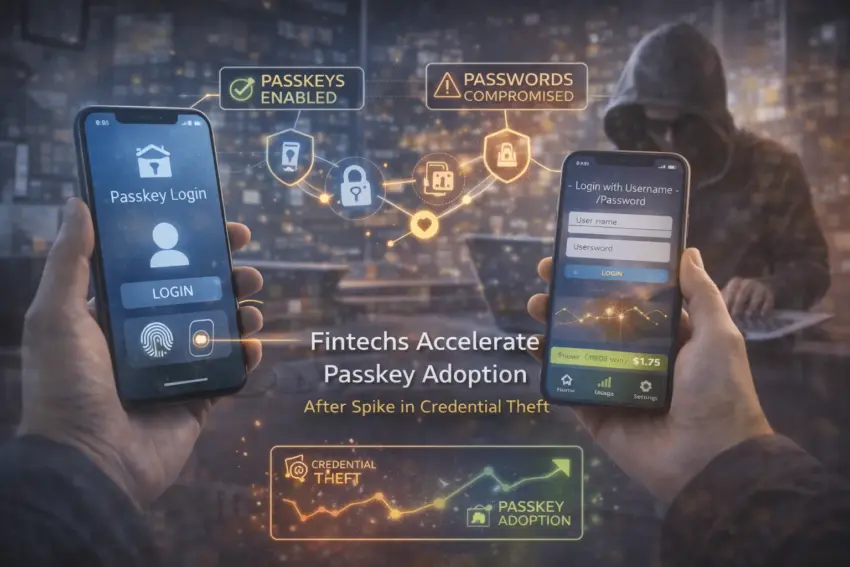
Fintech companies are accelerating the rollout of passkeys after a surge in credential theft highlighted the limits of password-based security. Several firms are expanding passkey support across mobile apps and web platforms, positioning the technology as a faster and safer alternative to passwords and one-time codes that can be phished, intercepted, or reused across services.
Passkeys are based on public-key cryptography and typically use a device’s built-in authentication—such as fingerprint, face recognition, or a local PIN—to confirm a login. Because there is no password to type or steal, attackers have fewer opportunities to trick users into handing over credentials via phishing pages that mimic legitimate banking or investment sites.
Why fintechs are moving faster now
Security teams in the financial sector say credential theft remains one of the most common starting points for account takeover. Attackers rely on reused passwords, data breaches, malware, and convincing social engineering to obtain logins, then exploit weak protections to initiate transfers or change account details. The rise of “phishing-as-a-service” toolkits has also lowered the barrier for launching large-scale campaigns targeting financial users.
Fintechs argue that passkeys reduce these risks by removing the primary target—passwords—while also improving user experience. Fewer login prompts can reduce friction during onboarding and daily use, and can cut support costs related to password resets and locked accounts.
How passkeys work in everyday use
With passkeys enabled, a user logs in by approving a prompt on their device or by using biometric authentication. The private key stays on the device, while the service stores a corresponding public key. When a login is requested, the device proves possession of the private key without sharing it—making it significantly harder for criminals to capture something reusable.
In practice, many fintechs are offering passkeys alongside existing methods, allowing customers to adopt them gradually. Some are presenting passkeys during high-risk actions—such as changing payout details or adding a new payee—where stronger authentication can prevent fraud.
What changes for customers
For users, the biggest visible change is that logging in can become a one-step process on devices that support passkeys. Instead of remembering complex passwords, customers authenticate with biometrics or a device PIN. Fintechs also highlight that passkeys can be synced across a user’s devices through platform mechanisms, reducing the risk of being locked out when switching phones—though institutions often keep fallback options for account recovery.
Remaining challenges and risks
Despite the security benefits, passkey adoption is not frictionless. Some customers are unfamiliar with the concept, and organizations must explain it clearly to avoid confusion with “passwordless” scams. Recovery flows remain a sensitive area: the most secure login can be undermined if attackers can easily bypass it through weak customer support processes or SIM-swap-friendly recovery methods.
Security specialists also note that device compromise, malicious apps, and social engineering can still play a role. Passkeys reduce phishing risk significantly, but they do not eliminate threats such as malware that takes over sessions or fraud that convinces users to approve actions they do not understand.
“Passkeys remove the password from the equation, which is a major win. But the security story still depends on strong recovery and transaction safeguards.”
What fintechs are adding alongside passkeys
To strengthen protection against account takeover, many fintechs are pairing passkeys with additional controls. Common measures include:
- Risk-based authentication that increases checks when logins come from new devices or unusual locations.
- Transaction verification with separate approval for high-value transfers or new beneficiaries.
- Device binding to link accounts to trusted devices and flag suspicious changes.
- Improved monitoring for abnormal behavior, including rapid credential attempts and unusual navigation patterns.
- Hardened account recovery to prevent social engineering and SIM-swap abuse.
Outlook for the sector
As credential theft continues to drive fraud losses, passkeys are likely to become a default login option in fintech apps, particularly for customers who primarily use mobile devices. Wider adoption will depend on clear customer communication, consistent cross-device support, and recovery procedures that are secure without being punitive.
For the fintech industry, the push toward passkeys signals a broader shift: security upgrades are increasingly framed not only as compliance measures, but as core product improvements that can reduce fraud and improve user trust at the same time.