
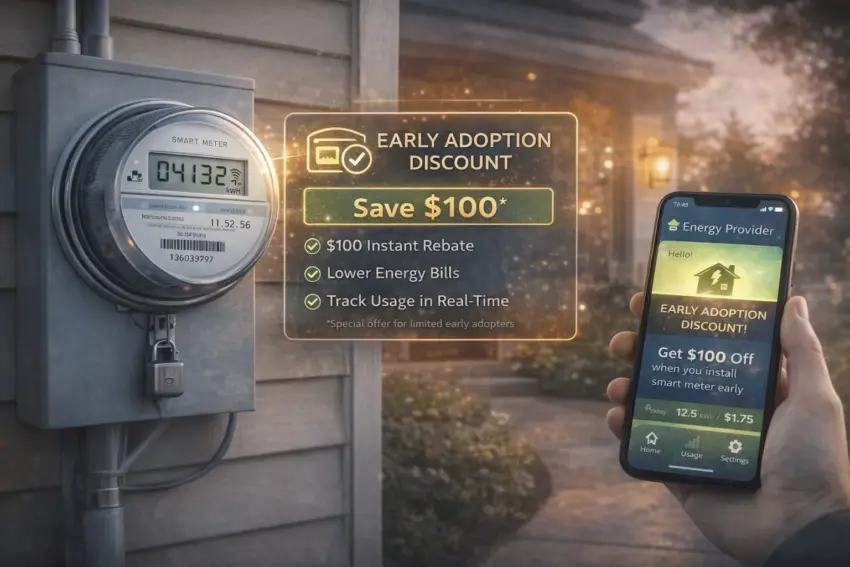
Energy providers are promoting discounts and bonus offers to speed up smart meter adoption, using early-adopter incentives to increase installation rates and shift more customers toward digital billing and data-driven energy services. Utilities argue that higher smart meter penetration improves billing accuracy, reduces manual meter reading, and supports more flexible grid management as EV charging and heat pumps expand.
For customers, the incentives can be attractive, but the value depends on the full tariff terms and any ongoing metering fees. Consumer advisers note that “discount” offers should be evaluated as total cost over the contract period, not only as a headline credit in the first months.
What early-adopter discounts usually look like
Offers differ by provider and region, but most fall into a few common formats:
- One-time credits applied after installation or after the first bill on a smart meter plan.
- Monthly bill reductions for a limited promotional period.
- Reduced service charges for digital billing or automated readings.
- Bundled “smart” tariffs that combine smart meters with time-of-use or dynamic pricing.
- Loyalty bonuses tied to staying on the plan for a minimum duration.
Some providers also include free access to an app or web dashboard that shows consumption by hour or day, helping households see where electricity use peaks.
Why utilities want early adoption
Smart meters support a more data-driven grid. With more frequent readings, utilities can forecast demand better, detect anomalies faster, and reduce disputes caused by estimated bills. In areas with rapid growth in EVs and electric heating, providers also see smart meters as a prerequisite for tariffs that encourage charging and heating outside peak hours.
From an operational standpoint, earlier adoption can reduce logistics costs by allowing installers to work through neighborhoods in batches and enabling providers to retire older manual processes sooner.
What customers can gain beyond the discount
Even without a special tariff, smart meters can improve transparency and reduce surprise bills by replacing estimates with actual readings. For households willing to adjust usage, the combination of smart meter data and time-based tariffs can unlock additional savings.
- Better consumption visibility to identify standby loads and inefficient appliances.
- Time-of-use benefits for people who can shift laundry, dishwashing, or EV charging to cheaper hours.
- Faster switching and move-in/out processes with fewer manual readings.
- More accurate billing with fewer corrections.
“The discount is temporary; the long-term value depends on whether the tariff and fees make sense for the household’s consumption pattern.”
What to check before accepting an offer
Before signing up, customers typically benefit from checking these details in the contract and product sheet:
- Ongoing meter or service fees and whether they increase after the promotional period.
- Tariff structure, especially if dynamic pricing could raise costs at certain times.
- Minimum contract term and any clawback rules if the customer switches early.
- Data handling: what granularity is collected and who can access it.
- Installation logistics, including appointment timing and what happens if installation is delayed.
Potential drawbacks and criticism
Consumer groups warn that some offers may shift costs from headline prices into fixed fees, which can disadvantage low-usage households. Others note that time-based tariffs benefit customers who can shift consumption, but may be less favorable for people with fixed schedules or high evening usage.
Utilities respond that smart meters improve billing accuracy and enable new tariff options, and that customers who prefer conventional pricing can often remain on standard plans.
What happens next
As smart meter rollouts scale up, early-adopter promotions may evolve into more targeted incentives—such as discounts for EV owners, heat-pump households, or customers who enroll in demand-response programs. The broader trend is that smart meters are becoming the gateway to new services, making it increasingly important for customers to compare offers based on total cost, tariff rules, and how well the plan fits daily energy use.